About this product
Most airdrop farming is guesswork: scroll Twitter, chase whatever is loud this week, spread thin across fifty protocols and hope. The Token Launch Radar replaces the guessing with arithmetic.
Point the skill at a sealed DefiLlama protocol snapshot (a single JSON file) and it:
- Finds the real candidates. It separates the protocols that record no token yet, then screens out the noise — wrapped, staked, bridged and restaked products of tokens that already trade (91 of them in the reference snapshot) are not launches and never reach the board.
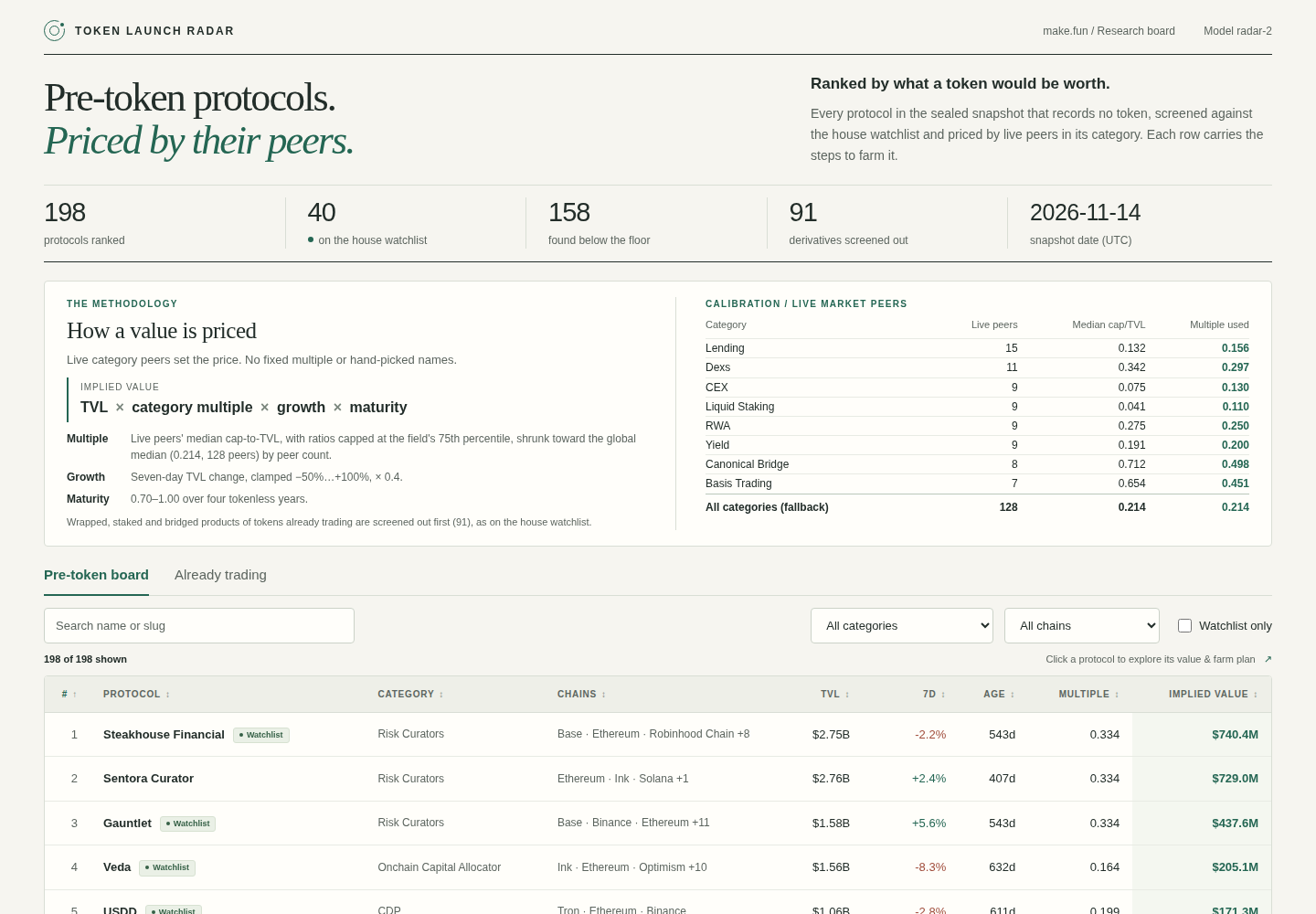
- Prices each one against its own category. The model (radar-2) calibrates a market-cap/TVL multiple from the live-token peers in the same category — median ratio, winsorized at the field's 75th percentile so one broken comp can't carry a category, then shrunk toward the global median by peer count. Implied value = TVL × category multiple × growth multiplier (7-day TVL momentum) × maturity multiplier (time operating tokenless).
- Shows its work. Every row of the board carries its full breakdown — multiple, peer count, peer median, growth and maturity multipliers — so you can re-derive any number yourself instead of trusting a black box.
- Tells you what to do. Each ranked protocol comes with a seven-step farm plan built from its category, chains, size and momentum, with a cost and a time estimate on every step.
- Ships a dashboard you'll actually open. A static HTML page — sort, filter by category / chain / watchlist, search, per-protocol detail views, plus a separate view of already-live tokens at market values. It makes zero network calls; open the file and it works.
On the reference snapshot (758 protocols, sealed 2026-11-14): 198 ranked rows, the full pre-token field down to a $5M TVL floor — not a cherry-picked top-20.
Fully offline and dependency-free. The engine is a single Node.js program (Node 22.18+, standard library only — nothing to install). It reads one local snapshot file, writes board.json, the dashboard, and a dossier.json. Your snapshot never leaves your machine.
What's in the package: the skill definition, the complete runnable engine (main.ts + model library + vendored dossier builder + dashboard assets), and a method reference explaining the calibration in full, constants included.
Honest limits: an implied value is a comparables estimate, not a prediction that a token will launch or what it will be worth, and a farm plan is research tooling — not financial advice. The board is only as current as the snapshot you feed it.